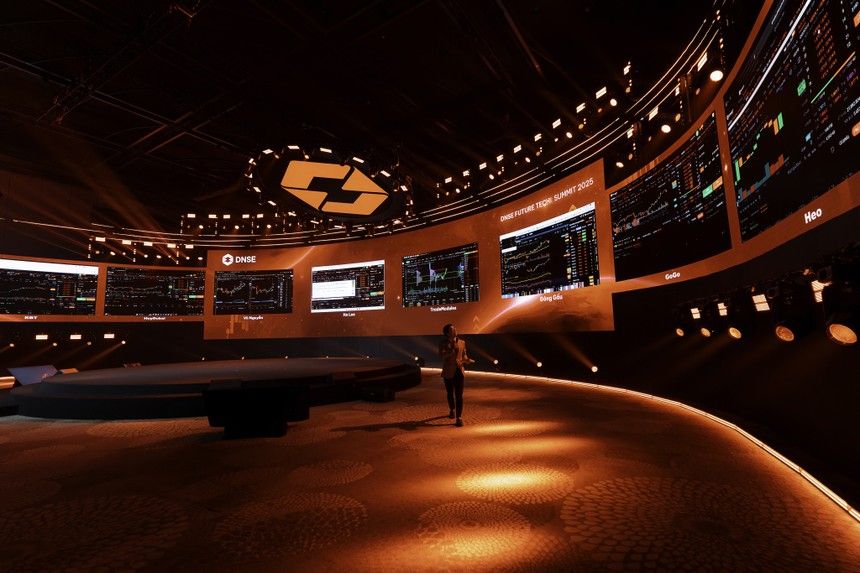



Vietnam’s stock market is entering a new phase of competition in which trading fees and brokerage service quality are no longer the decisive differentiators. With FTSE Russell set to reclassify Vietnam as a Secondary Emerging Market from September 2026, the competitive pressure facing securities firms is shifting in a different direction.
The new battleground lies in their ability to invest in digital infrastructure, harness data effectively, and demonstrate readiness to deploy artificial intelligence in real-world operations. Technology, once largely a back-end support function, is increasingly becoming a direct measure of competitiveness among securities companies.
Bringing institutional-grade tools to retail investors
Amid this industry-wide transformation, DNSE has taken a distinctive approach to the technology race: building full in-house technological capabilities rather than relying on third-party solutions. Through continued investment in strengthening its technology platform, the company’s trading system has maintained ultra-low and stable order-processing latency of approximately five milliseconds, even when transaction volumes surge tenfold. Building on this robust technological foundation, DNSE has moved beyond experimentation and embedded AI directly into the everyday trading experience of retail investors.
A notable example is its “AI Order” feature integrated into the company’s securities trading application. Instead of having to constantly monitor live price boards or worry about revealing their trading intentions when placing large orders, investors can allow the system to automatically track market movements and break a large order into smaller orders distributed throughout the trading session. These sophisticated execution algorithms were once accessible primarily to large institutional funds with the resources to deploy them. DNSE has now made such tools available to retail investors. One year after launch, the feature has attracted nearly 12,000 users, with total trading value reaching hundreds of billions of Vietnamese dong.

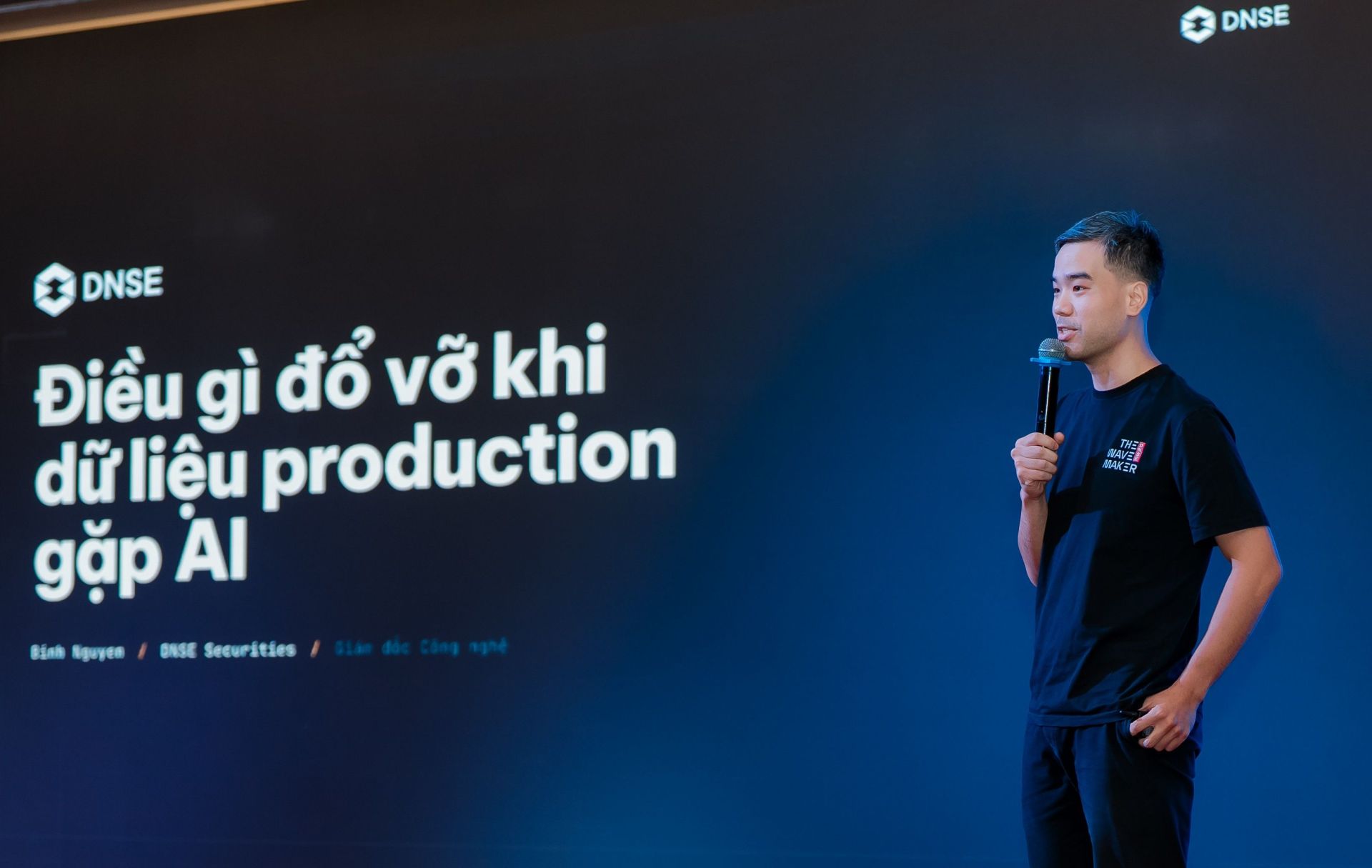
Alongside this offering, DNSE’s intelligent virtual assistant, Ensa, helps answer millions of stock market-related queries from investors every day. Yet behind this seamless and convenient user experience lies a highly complex technical challenge, as Nguyễn Đức Bình, Chief Technology Officer of DNSE, recently explained at the “Modern Architecture for the AI Era” event organized by FPT.
When AI exposes the hidden cracks in trading data
According to Bình, allowing AI to directly interpret account data, analyze orders, and make decisions on behalf of humans within a securities trading system is akin to handing the controls of a high-speed machine to an automated operator. The key issue, he noted, is that AI does not necessarily create new errors. Rather, it acts as a microscope, magnifying every data flaw and inconsistency that may have remained hidden within a core trading system for years.
In the past, when humans still served as an intermediary layer for order review or manual risk management, minor data inconsistencies could often be compensated for through professional judgment and experience. Once AI is introduced into automated operations, however, those same gaps can quickly escalate into significant risks.
Bình identified three major data bottlenecks that any securities firm seeking to deploy AI must address. These are also the areas DNSE has prioritized before scaling AI applications across its products:
- Misalignment across management systems: The same account-related term may carry different meanings across different systems. For example, the “Active” status of an investor may mean that customer identification has been completed in the customer relationship management system, that the account holds cash or securities in the core trading system, or that the client has never breached trading rules in the risk management system. If AI simultaneously scans all three systems without an appropriate reconciliation mechanism, it may reach fundamentally incorrect conclusions about the customer’s status or eligibility.
- Controlling AI access and authorization: Intelligent AI assistants tend to retrieve information automatically from multiple databases in order to respond to users. Without carefully designed safeguards, an AI system could inadvertently access or expose sensitive information beyond the authorization level of the person making the request.
- Silent changes in data structures: An AI model is typically developed around a specific data structure. Yet in the day-to-day operation of a securities company, engineers may add, remove, or modify data fields without updating the AI system accordingly. The model may then continue running and generating inferences based on a data foundation that has gradually become misaligned, creating latent risks in automated decision-making that may go unnoticed until a serious incident occurs.
This challenge reflects a broader reality across the global financial industry. International surveys indicate that more than one-third of financial leaders regard data quality as both the biggest barrier and the greatest opportunity as their organizations move into the AI era.
Fixing vulnerabilities at the foundation so speed does not come at the expense of risk
Recognizing these potential pitfalls, DNSE has shifted its technology strategy from addressing problems reactively at the surface level to rebuilding and reinforcing the underlying foundations. Software systems need to be modularized to prevent bottlenecks. Securities-related concepts and terminology need to be standardized so that all systems operate with a consistent language. At the same time, even the smallest changes to data structures must be subject to strict governance and control before being deployed into production.
As international capital flows and new market standards draw closer following Vietnam’s market reclassification, the quality of data infrastructure will increasingly determine which securities firms are positioned to succeed and which are left behind.
As Bình put it: “AI does not create problems. It simply makes them impossible to hide.” Ultimately, artificial intelligence does not generate these underlying weaknesses on its own. Instead, it serves as an uncompromising mirror, allowing financial institutions to identify clearly, and address decisively the technical vulnerabilities that may have remained unresolved for years.
Source: Vietstock