


IR serves as an “operating system” for a company in the capital markets, continuously built and operated to connect information, corporate strategy, and investor expectations. A good “operating system” needs to be built and continuously run throughout each stage of the process.
A company may attract investors’ attention in the short term through communications, but in the long term, it can only retain their confidence through business performance, as well as discipline and consistency in its IR activities.
A conversation with Mr. Nguyen Hoang Viet offers further insights into the role of IR in attracting capital inflows, as well as the keys to successful IPOs, M&A transactions, and corporate restructuring.
From the perspective of an advisor such as DNSE, how early should IR activities supporting an IPO begin?
Mr. Nguyen Hoang Viet: IR activities supporting an IPO are not merely a few events taking place around the time of the IPO, but rather a process of building investor confidence. Therefore, a sufficiently early starting point would typically be 12–24 months before filing the IPO application, and ideally, as soon as the Board of Directors agrees to pursue an IPO as a strategic objective.
Of course, this is not a fixed legal timeline, but depends on the specific circumstances of each company. For investors to have confidence in investing, or at the very least to become aware of the company, sufficient time is needed to establish a verifiable track record of information and build investor confidence before seeking to attract investors.
In practice, a company cannot offer shares when investors have little or no knowledge of the company. This has been seen in several recent IPOs by manufacturing companies, where IR activities only began close to the commencement of the IPO process, resulting in distribution volumes falling short of expectations.
Looking at the process in greater detail, which stages should companies focus on during an IPO?
Based on our experience advising companies on IPOs, I believe that the following key factors should be emphasized across the four stages of the IPO process:
12–24 months before the IPO: The company should standardize its governance, auditing, legal framework, data systems, and operating metrics; clearly define its investment story, use of proceeds, and key risks. During this stage, the IR team should begin developing a communications plan, defining the company’s story, as well as the key information and highlights of the IPO.
Approximately 6–12 months before the IPO: This is the period when IR activities need to be significantly intensified to communicate management’s messages, development strategy, and the company’s growth potential. At the same time, the company should carefully prepare bilingual materials, anticipate and prepare responses to challenging questions and concerns from investors, and accurately identify the target investor groups to approach.
IPO implementation stage: The company should organize roadshows, either in Vietnam or overseas, or meetings with brokerage groups and high-net-worth individual investors through securities companies, in order to provide more detailed information about the company. These engagements also provide opportunities to directly address investors’ questions and strengthen their confidence in the management team and the company.
Post-listing stage: IR activities must continue to be maintained on a regular basis, with updates on business and operational performance to demonstrate that the company is delivering on its commitments.
DNSE successfully completed its IPO in 2024. What formula did the company apply to achieve this success?
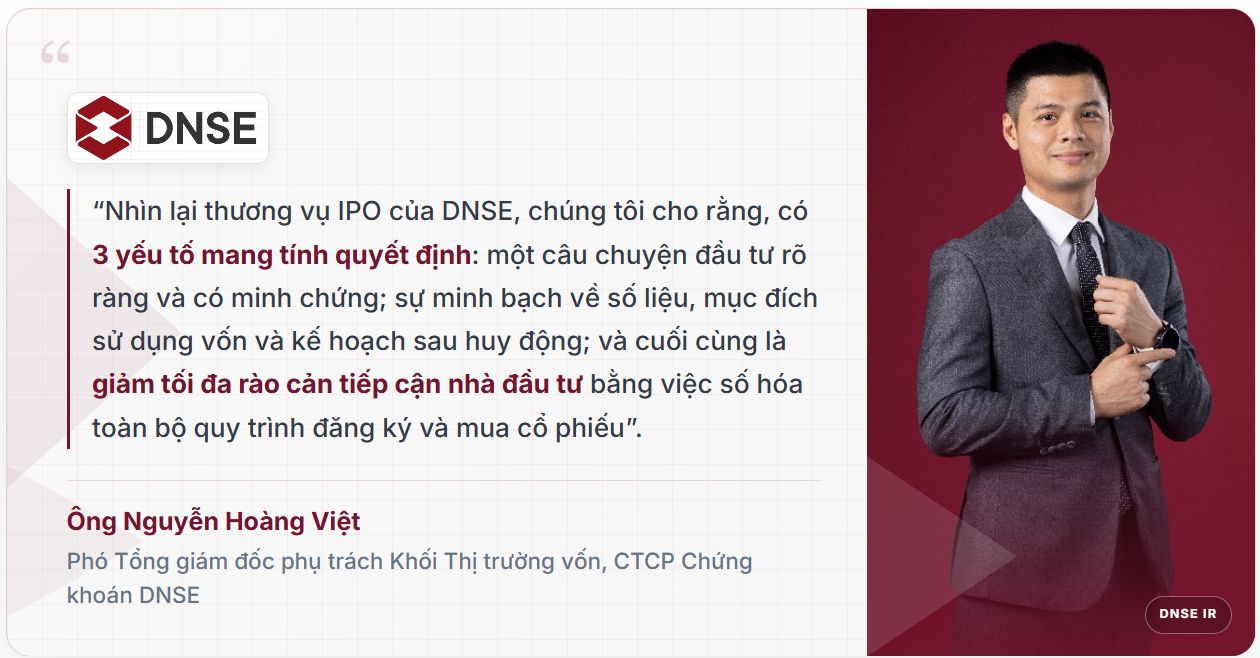
For DNSE’s IPO, we also identified three decisive factors. First, we developed a clear investment story supported by specific evidence. DNSE positioned itself as a technology-driven securities company, with a differentiated business model and digital experience, along with strong growth potential. Second was transparency in financial data, the use of proceeds, and post-fundraising plans. Third was minimizing barriers to access: the IPO registration and share purchase process was conducted entirely online. At the time, DNSE was a pioneer in implementing this IPO model, leveraging its technological advantages.
During the nearly one-month offering period, more than 2,600 investors registered to purchase shares, and DNSE successfully distributed 30 million shares, raising VND 900 billion. On July 1, 2024, 330 million DSE shares were officially listed for trading on HOSE, in line with the commitments made to investors.
Looking back, from the time we took over Dai Nam Securities in the second half of 2020, renamed it DNSE Securities, and increased charter capital to VND 3,000 billion at the end of 2021, the Board of Directors had already developed plans and begun preparing for an IPO in 2023–2024. Accordingly, the preparation process started at a very early stage.
Communications and investor relations activities were invested in and implemented extensively to gradually bring information about DNSE to the public and build the company’s reputation and brand among the public over a sufficiently long period, before we officially entered the IPO phase.
IR and Capital Raising: How Can Companies Strengthen Investor Confidence?
Being known and gaining investors’ attention is already a challenge, but how can a company persuade investors to make a long-term investment? In your view, what IR strategies and practices should companies adopt to attract capital?
In my view, investor confidence needs to be built gradually over time, through consistency between what a company says, the data it discloses, and the results it delivers. Therefore, effective IR should first and foremost be a transparent and efficient information management process. Information must be accurate, complete, timely, and comparable. When results are unfavorable or there is information that may affect business operations, the company should proactively explain the causes, impacts, and remedial measures rather than avoid the issue. When raising capital, the company must clearly communicate how the funds will be used, the progress of disbursement, which indicators will reflect the effectiveness of the capital raised, and when reports will be provided so that investors can assess the results.
To provide investors with clear, transparent, and timely information and strengthen their confidence, companies can use various channels, such as email communications and two-way dialogues between company management and investors through regular or ad hoc Earnings Calls.
At DNSE, we maintain a monthly Shareholder Newsletter as a regular channel of dialogue with investors. It not only updates financial and operational metrics but also proactively explains the factors affecting business performance, changes in operations, and the company’s direction for the next stage. This enables investors to continuously monitor DNSE and assess actual results against the directions and commitments made by the company.
Every six months, following the completion of audits and reviews of our financial statements, we organize an Earnings Call where representatives of the Management Board present the company’s performance and have the opportunity to respond to investors’ questions. At the same time, throughout the year, we select international markets in the region to introduce DNSE to investors. As a result, we have successfully distributed our shares and attracted a large number of investors in our equity capital raisings and bond issuances.
Clearly, IR serves as the bridge that transforms a company’s capabilities and transparency into investor confidence, thereby enhancing its ability to raise capital and create corporate value.
“Investor confidence needs to be built gradually over time, through consistency between what a company says, the data it discloses, and the results it delivers.”
Mr. Nguyen Hoang Viet
Deputy General Director in charge of Capital Markets Division, DNSE Securities Joint Stock Company
In the context of Vietnam’s market reaching out to the international stage, how does IR support companies in expanding their markets and accessing international investors?
In practice, DNSE is one of the companies that places strong emphasis on expanding access to international investors. Before and after our IPO, we successfully attracted investment from reputable international funds such as PYN Elite Fund (Finland) and Consilium Investment Management (the United States). Currently, our IR team continues to regularly conduct investor outreach trips to potential markets such as Singapore, Thailand, and Japan to expand our market reach.
In several recent IPOs by securities companies in the market, many businesses have also been proactive in traveling to international markets to seek investors. Instead of simply being in a position where they “can be found,” these international roadshows enable companies to shift toward “actively seeking” investors and becoming “investable.” However, attracting international investors requires corporate IR teams to prepare and plan extremely carefully; it is not simply a matter of “pitching” the company.
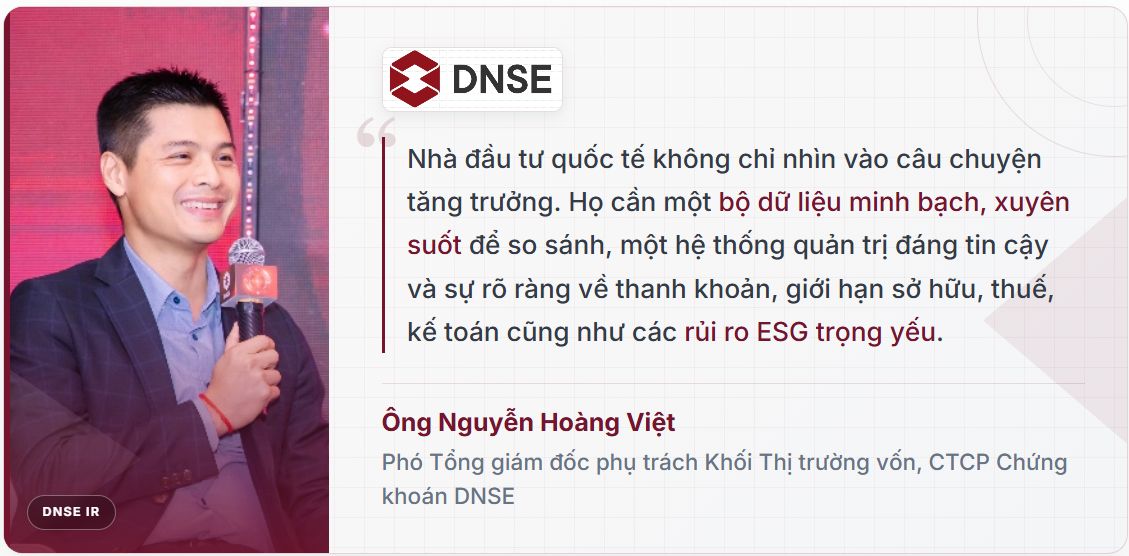
International investors are typically large asset management funds, managing assets ranging from tens to hundreds of millions of US dollars, and even billions of US dollars. They consider not only the growth story - which is one of the most important factors - but also comparable data, the development track record of the management team, and the company-building process. In addition, they closely assess whether the corporate governance framework is reliable, as well as the clarity of liquidity, ownership limits, fund transfers, taxation, accounting, and key ESG risks.
Therefore, to successfully reach and attract international investors, we believe that a company’s IR team needs to carefully prepare the following: (1) prepare and publish bilingual financial statements simultaneously; (2) maintain 3–5 years of historical data with clear and consistent key metrics; (3) provide information on the free-float ratio, foreign ownership limit (foreign room), and liquidity; and (4) maintain a regular investor engagement schedule through non-deal roadshows, investor conferences, analyst briefings, and direct Q&A channels.
IR Is About Making a Company’s Intrinsic Value More Visible and Clearly Understood
What requirements does the important role of IR in attracting foreign capital place on IR teams? How can companies strengthen their IR capabilities and practices?
For these areas of work, IR teams need to have strong experience and professional expertise, or they can work with securities companies—professional service providers in this field.
Securities companies/advisors can support businesses in identifying suitable investor groups based on industry, size, investment horizon, and risk appetite; standardizing the company’s equity story and materials; conducting pre-sounding with investors to understand valuation or other terms that may be barriers; and providing market feedback on decisions relating to corporate governance, capital structure, or shareholder policies.
In my view, the most important factors in attracting investors and retaining international capital are asset quality, business performance, and consistency in execution. The role of the IR team or advisor is to serve as a bridge and communication channel, enabling the company’s story to reach investors as effectively as possible.
For companies preparing for an IPO, M&A transaction, or capital raising, how should IR be prepared and implemented to both meet market requirements and enhance corporate value?
We view IR as an “operating system” for a company in the capital markets, continuously built and operated to connect information, corporate strategy, and investor expectations. A good “operating system” needs to be built and continuously run over a certain period across the following areas:
Readiness in financial information and management reporting: The company needs an authorized IR point of contact, coordination processes among the finance, legal, strategy, operations, and communications functions, as well as a clear information-sharing mechanism.
Building the investment story and valuation framework: The investment story must answer questions such as how the company creates value, how new capital will change its earnings capacity, and what risks could prevent the plan from being achieved. For this work, IR teams need strong experience and professional expertise or should work closely with securities companies.
Establishing an information disclosure process: The company’s IR team needs a single source of truth for data - with consistent figures, KPIs, definitions, and messaging across the offering documents, financial statements, IR website, presentation materials, and management communications.
Continuously expanding investor access: IR should maintain a regular schedule of disclosures and dialogue, even when there is no transaction underway, including business performance updates, Earnings Calls, annual reports, General Meetings of Shareholders, and investor meetings.
If IR only begins when the IPO documents are nearly complete or when the company needs funding, it often becomes a short-term reactive function and is unlikely to build sustainable investor confidence.
| 01. Readiness in Financial Information and Management Reporting | 02. Building the Investment Story and Valuation Framework | 03. Establishing an Information Disclosure Process | 04. Continuously Expanding Investor Access |
| The company needs an authorized IR point of contact, coordination processes among the finance, legal, strategy, operations, and communications functions, as well as a clear information-sharing mechanism. | The investment story must answer questions such as how the company creates value, how new capital will change its earnings capacity, and what risks could prevent the plan from being achieved. For this work, IR teams need strong experience and professional expertise or should work closely with securities companies. | The company’s IR team needs a single source of truth for data - consistent figures, KPIs, definitions, and messaging across offering documents, financial statements, the IR website, presentation materials, and management communications. | IR should maintain a regular schedule of disclosures and dialogue, even when there is no transaction underway, including business performance updates, Earnings Calls, annual reports, General Meetings of Shareholders, and investor meetings. |
From the perspective of an advisor, what do you believe are the core factors that enable a company to attract capital from the market?
For our advisory clients, DNSE typically begins by assessing their level of readiness, then works with the company to develop its equity story, financial model and KPIs, and data repository. This is followed by identifying potential investors and carrying out communications activities before and during the IPO, as well as investor roadshows and meetings.
For M&A transactions or restructuring, the scope also includes messaging for relevant stakeholder groups, rumor scenarios, confidentiality principles, and a set of post-transaction performance indicators for monitoring.
However, in my view, no IR team in the market can create value on its own if the company’s business operations and governance are unclear, non-transparent, and ineffective. The proper role of IR is to make the company’s intrinsic value more fully and clearly visible, enabling the market to assess the company based on fair and consistent information. Therefore, companies should take note of several pitfalls to avoid: starting IR activities too late, equating IR with PR, and communicating messages that go beyond the company’s execution capabilities.
I believe that a company can attract investors’ attention in the short term through communications, but in the long term, we can only retain their confidence through business performance, as well as discipline and consistency in IR activities.
Thank you, Mr. Viet.
Source: Vietstock